The Nightmare Bicycle is a blog post I recently came across, and it got me pondering its implications on how products are designed. The core argument being made is that exposing how a system works is often a better solution than abstracting it with arbitrary labels on top of it. The star example is a bicycle with gears that aren’t numbered in the classic 1-6 ordering but instead have labels like Gravel, Uphill, or Pavement to represent their function. What happens then, if the user needs to go uphill on a gravel road? How would they know which gear to change to? The author proposes that numbered gears are a better solution here because it allows people to create mental models of a higher number equating to more treacherous terrain that can adapt to a near-infinite canvas of of real world scenarios which aren’t limited to the six you can label on a bicycle gear.
I get the argument, but it misses critical insights about how people actually buy and use products. For one, there is a learning curve to understanding how the system works. Nobody can tell you exactly which terrain Gear 4 is the best fit for before they’ve ever ridden a bicycle. It requires trial-and-error and learned intuition over time to form the mental model and it isn’t an appropriate fit for products which you need to immediately understand how to use without needing a learning curve. I disagree with the author’s philosophy of “People are smart, they will figure it out” as an alternative to actually doing the deep thinking and design work required to figuring out how to make some intuitive and understandable at first glance. Imagine needing to learn how to use a product every single time instead of it just working the way you would expect it to, and then imagine doing this for every new product you purchase for the rest of your life. You would need to store hundreds of mental models of how different objects function in your working memory, which would be the actual nightmare scenario.
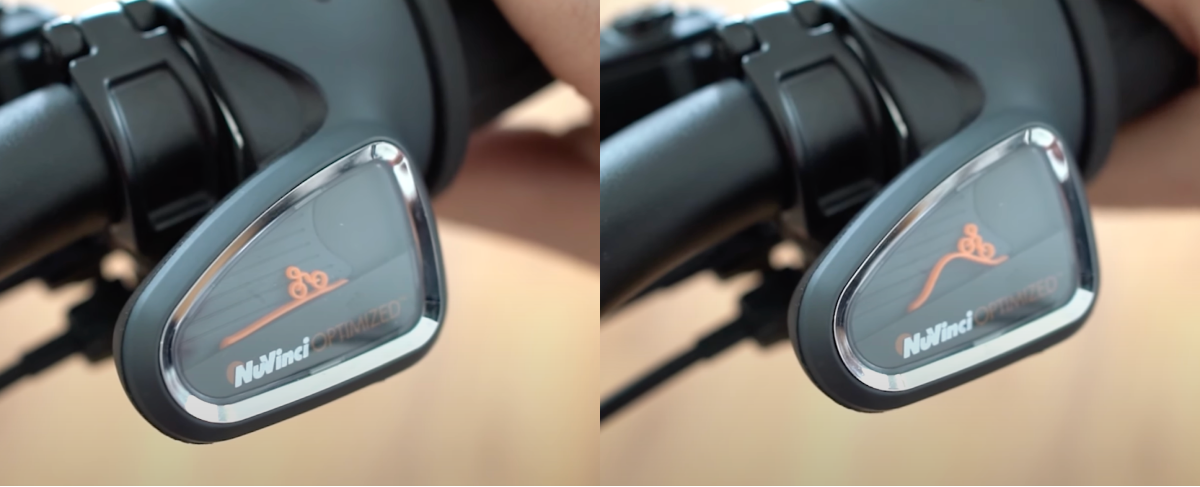
• • •
The moment of making a buying decision is a critical nuance here. Let’s say you were buying a microwave and you were debating between two models: one that just had a number pad to set the time with some power level options and another that had the same controls but also came with bunch of presets for Popcorn, Meat, Fish, Defrost, Potato, and Pizza. The one with the presets is clearly signaling that you are meant to cook food in it, and even someone who didn’t know what a microwave was can figure out what to do with the object. More importantly, the purchasing decision here by the customer isn’t being made based on the wattage or power of the microwave. Manufacturers understand this, and they want to sell the fantasy of convenience: hit one button for fast and easy hot food. Why figure out exactly how long you need to defrost your meat when you can just pop it in and hit the defrost button?
These are shortcuts that save their customers time and it’s often marketed as a big selling point for these microwaves. You also get the added bonus of selling to a customer that had no idea you could heat up potatoes in a microwave in the first place. In this case, adding these abstractions actually have a direct benefit to the user at the point of sale, but you do continue to have the added problem of not knowing how to use the product if you were trying to heat up something that wasn’t one of the presets and required a specific combination of power level and cook time that you never built your mental model for. The key takeaway here is that these presets cannot be a direct replacement for the numbers and power levels, they must be additive functions on top of those to be useful and meaningful.
• • •
Game controllers are another interesting example where exposing the system actually does benefit everyone. The A button on most controllers is used for confirm or proceed actions and the B button is used for cancel or backwards navigation in menus. This is a pattern that has been standardized over the years with every developer trying their best to stick to intuitive controls. It would be very ill-conceived of a Product Manager to suggest that they should simply rename the A & B buttons to Accept or Decline. Sure, it helps make the function of these things more intuitive at first-glance, but they are used for far more than that.
Each game creates custom mappings for these buttons that fit its gameplay. For example, A could get mapped to jump and B could get mapped to dodge. Calling the buttons Accept or Decline would be disasrous in games that would instruct you to press “Accept” to interact with an object or press “Decline” to sprint forwards. The best solution here is to just keep them abstract symbols and let individual applications control the mapping for their game’s context. Creators of products need to fully understand all the contexts that their product will be used in before making sweeping decisions like this.
• • •
Preset shooting modes on point-and-shoot cameras are another great case study to explore. If you were a novice photographer in the market for a camera and saw one that had shooting modes for Flowers, Wildlife, and Landscape, you would immediately light up and think it’s a great deal. No tinkering with complex settings when you see an elusive animal — just switch to Wildlife and click! This is also exactly how these cameras are marketed. The presets help accelerate the learning curve for an art form that has an exceptionally high skill ceiling.
You could spend a lifetime perfecting the right combination of Aperture, Shutter Speed, and ISO on DSLR cameras. And many professional photographers do. When the northern lights dazzle for a brief few seconds, they know how to quickly set the shutter speed to 1/4th of a second and crank the ISO up to 2000 and quickly capture the moment before it’s gone. But would the novice photographer know how to do this? No. They would fiddle around by trying to set it to Night mode and then be disappointed when it got a blurry or overexposed image. They would try again by setting it to Sky or Landscape with similarly disastrous results.
And this is okay. The novice photographer does not need to know how to capture every moment at every time in any lighting condition. The presets are meant to get them comfortable with shooting different types of scenes and exploring the art form. At their level, they are more focused on sharpening their sense of compositional layouts, identifying interesting subjects, and capturing intimate moments. There will come a time when they realize they they weren’t able to get that shot the way they wanted of a dog sprinting across a field of flowers because they couldn’t figure out if they should be on the Wildlife or Flowers setting, and that’s when they’ll decide to upgrade and learn the actual systems of how camera modes actually work. In this instance, the point-and-shoot camera has done its job of up-leveling this hobbyist photographer into a professionally-curious one. That camera isn’t a failed or poorly designed product, it’s simply serving a different need.
I believe that there’s a market for simple versions of complex products that benefit greatly from beginner-friendly labeling. Coffee machines are a great example where most people don’t want the overcomplicated functions of a barista-grade espresso machine and literally just want to hit a button every morning that makes great coffee consistently. You really do not want to be tinkering with dials and knobs to figure out how an espresso machine works at 6:00 AM in the morning when you’re running late for work.
• • •
Perhaps the best version is one where the system has smart defaults while is also exposing to the user what it’s actually tweaking in the system. Your TV has picture modes for Movie, Sports, Games, or maybe even a Filmmaker Mode. You probably have no idea what these actually do until you flip through them. Some increase the saturation, others decrease the contrast, and some pump up the HDR or brightness. The best implementation of this is in TVs that show you exactly what’s changing on the control sliders for all these fine-tuned settings like Contrast, Brightness, and Saturation as you flip through the Picture Modes in a side panel. This allows you to understand both what the most commonly used options are while also letting you peek at what’s happening behind the scenes in each of those settings.
This solves the point-of-sale problem elegantly by allowing users to imagine the kinds of content they could watch on the TV while playing with it in the store. And it helps them build a mental model of how the settings work so that they can in the future make their own custom setting when they want to watch a movie about sports or play a cinematic video game. This is trickier to pull off in a hardware product with limited controls like a blender or a speaker, but this is exactly where I think the design effort should be spent on those products. The designers need to work on finding ways to quickly explain the most common use cases and how those things modify the system’s behavior in an intuitive manner.
• • •
On a bicycle, the geared numbers correspond to the increasing rate of revolution of the bike wheels for every stroke of the pedal. Did you actually know that? I certainly didn’t. I learned through years of intuition that higher gears require more effort and are better suited to hills and rocky terrain. But in this day and age, I don’t have years to form a mental model for every new piece of software and physical product I buy. I want it to be immediately understandable and work the way I expect it to. Don’t make me think.
This is as much a design problem as it is a marketing and sales problem. The product needs to be understandable when you look at it on the box or on a store website and you need to know exactly how to operate it just by looking at a static image of it. Then when you purchase it, it needs to conform to those expectations by being intuitive and simple to operate. It then needs to show you the most common ways that you would use it while also showing you what those “modes” are changing behind the scenes, empowering you to create your own custom mode over time if you so desire.
You can’t create your own gears on a bicycle due to the physical limitations of the mechanisms, but it can at the very least indicate what the numbers mean. Icons, simple visuals, or even accompanying text next to the numeric label can go a long way in educating novice bikers about what bicycle gears do and how they work. They also help experienced bikers build a mental model over time. They could go over that hill in the distance if they wanted to because they see that one of their gears is explicitly made for the Hill setting but also means that it’s requiring more effort from your end to pedal on the mode. That would be the dream bicycle.